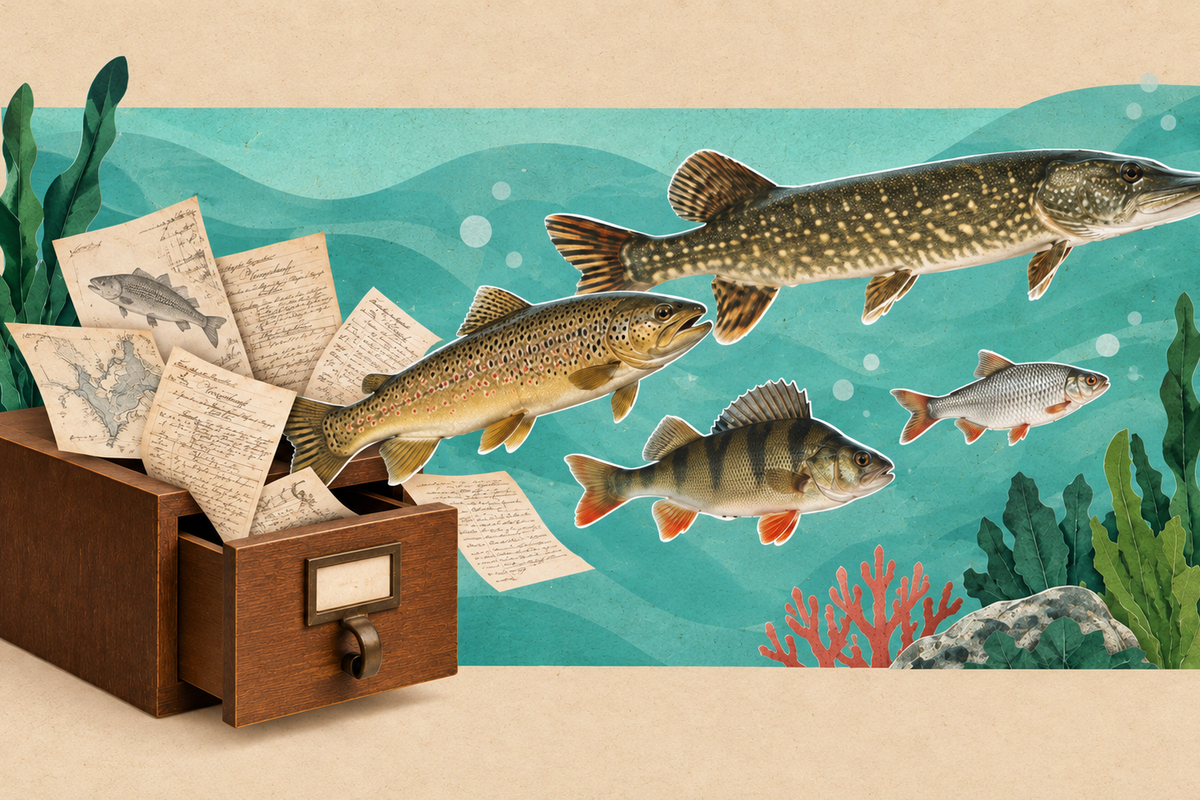
How can fish observations contributed by a wide range of individuals and groups be transformed into a reliable research dataset available internationally? A new data paper on the GfI Fish Species Atlas documents this process. Claas-Thido Pfaff, a software developer and member of the GFBio team, was among the contributors to this exciting publication.
Determining where a particular fish species occurs is often far from straightforward. The relevant information is scattered across scientific publications, official reports, regional databases and observations collected by volunteers. The data also often vary considerably in terms of accuracy, survey methods and documentation.
A new data paper published in the Biodiversity Data Journal, the Data Paper on the GfI Fish Species Atlas, demonstrates how such heterogeneous data can be reviewed, standardised and prepared for research. It uses a dataset from the Fish Species Atlas of the German Ichthyological Society (GfI) as an example. In this way, 62,545 records covering 264 freshwater and marine fish species from 16 European countries were published via the international biodiversity research platform GBIF and shared with researchers worldwide.
The paper serves as both scientific documentation and an interpretive guide. It provides a transparent account of how information from scientific and grey literature, regional databases and citizen-science observations was consolidated, standardised and reviewed. It also documents the provenance of the records, spatial inaccuracies and the reconciliation of different species names. In addition, it highlights an important limitation: the atlas records species occurrences but does not systematically document their absence.
The publication therefore provides valuable guidance for a range of groups:
- Researchers are able to make informed assessments of which data are suitable for their research questions.
- Scientific societies, museums, public authorities and citizen-science projects can learn how historically accumulated datasets can be made accessible.
- Research infrastructures and funding institutions gain insight into the human, technical and legal work required to make valuable community data reusable in the long term.
The work began as a use case during the first funding phase of NFDI4Biodiversity. GFBio contributed both scientific expertise and support in clarifying the legal requirements. In addition to Claas-Thido Pfaff’s involvement in the data paper, GFBio funded a legal opinion on copyright, data protection, research ethics and the licensing of species-occurrence data. Its recommendations informed the publication of the data.
The Fish Species Atlas thus demonstrates how biodiversity data accumulated over many years can be made available in accordance with the FAIR principles—that is, in a findable, accessible, interoperable and reusable form—and can also serve as a model for similar initiatives.
Learn more about how the dataset was created and about the ongoing collaboration in the detailed article by NFDI4Biodiversity.
Publication
Brunken H., Braubach L., Engel T., Grobe P., Pfaff C.-T., Rach B., Vatterrott H.-R., Friedrichs-Manthey M. (2026), The “GfI-Fischartenatlas” of the German Ichthyological Society (GfI) - A compilation of validated fish species occurrence records. Biodiversity Data Journal 14: e201405. https://doi.org/10.3897/BDJ.14.e201405